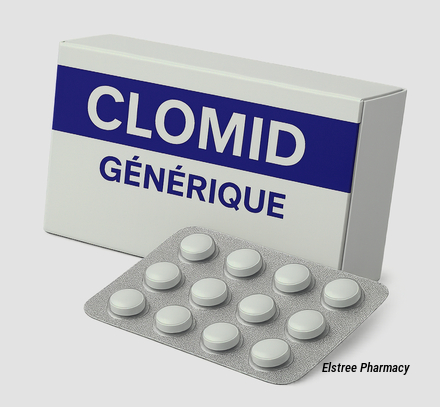
Clomiphene citrate, commonly branded as Clomid, is a prescription-only medicine (POM) in the United Kingdom. It cannot be legally supplied without a valid prescription from a qualified healthcare professional. Any website or pharmacy offering Clomid without prescription in the UK is operating outside the legal framework and may present risks related to product authenticity, safety and proper dosing guidance. While we understand the desire to purchase, buy or order Clomid cheap online, UK regulations require that clomiphene citrate is dispensed by registered pharmacies upon receipt of a doctor’s prescription.
At Elstree Pharmacy, we can guide you on how to obtain a prescription via your GP or private consultant and then provide you with high-quality generic Clomid at competitive prices. Ordering clomiphene citrate through reputable UK channels protects you from counterfeit or substandard products and ensures you receive expert counselling on dosing, side effects and monitoring.
The United Kingdom classifies medicines under three main legal categories: Prescription Only Medicine (POM), Pharmacy Medicine (P) and General Sales List (GSL). Clomiphene citrate is categorized as a POM, meaning its supply must follow strict legal requirements. A prescription-only classification ensures that medications with potential adverse effects, specialised dosing or complex monitoring are supervised by healthcare professionals.
Self-prescribing or sourcing POMs like Clomid online without a prescription can expose patients to wrong dosing, dangerous drug interactions and absence of appropriate follow-up. By contrast, P and GSL categories include lower-risk products that may be supplied by pharmacists or sold widely, but they are not suitable for fertility agents like clomiphene citrate.
Clomid is the brand name for clomiphene citrate, an oral medication widely used to induce ovulation in women with certain types of infertility. First synthesised in the 1950s, clomiphene citrate remains a first-line ovulation inducer thanks to its efficacy, relatively low cost and oral administration.
The active pharmaceutical ingredient in Clomid is clomiphene citrate. It belongs to a class known as selective estrogen receptor modulators (SERMs), which exert modulatory effects on estrogen receptors in the hypothalamus and pituitary gland.
Clomiphene citrate promotes the release of gonadotropins—luteinizing hormone (LH) and follicle-stimulating hormone (FSH)—by blocking estrogen feedback at the hypothalamus. The resulting surge in LH and FSH can stimulate ovarian follicle development and ovulation, making Clomid a cornerstone in the management of anovulatory infertility.
No. Clomiphene citrate is not estrogen; it is a synthetic compound that binds to estrogen receptors. It acts as both an estrogen antagonist in some tissues and an agonist in others, ultimately tricking the body into producing more gonadotropins.
Multiple pharmaceutical manufacturers produce generic clomiphene citrate under licence in the UK and Europe. Generic Clomid is bioequivalent to the brand-name product, meeting stringent quality, safety and efficacy standards set by the MHRA and EMA.
Generic Clomid offers the same active ingredient, strength and therapeutic effect as the branded formulation but often at a lower price. Depending on the number of cycles prescribed, switching to generic clomiphene citrate can result in significant cost savings.
Clomiphene citrate binds to estrogen receptors in the hypothalamus, preventing natural estrogen from exerting negative feedback. The hypothalamus perceives a low-estrogen state, increasing the release of gonadotropin-releasing hormone (GnRH). Elevated GnRH drives pituitary secretion of FSH and LH, promoting follicle growth and ovulation.
The standard regimen involves 50 mg of clomiphene citrate daily for five days, usually beginning on day 2, 3 or 5 of the menstrual cycle. If ovulation does not occur, the dose may be increased to 100 mg daily for subsequent cycles under medical supervision.
A healthcare provider may monitor treatment by tracking menstrual cycles, serum hormone levels, and ultrasound follicular scans to assess ovarian response and reduce the risk of ovarian hyperstimulation.
Excessive ovarian response can lead to multiple follicles maturing simultaneously, raising the risk of twin or higher-order pregnancies as well as ovarian hyperstimulation syndrome (OHSS). Proper dose adjustment and monitoring mitigate these risks.
Off-label, clomiphene citrate has been used to raise endogenous testosterone levels in men by increasing LH and FSH. This can support spermatogenesis in cases of hypogonadism, though evidence and protocols differ from female fertility use.
Prices vary by pack size, supplier and brand. Elstree Pharmacy offers competitively priced generic clomiphene citrate. For current prices and special offers—such as multi-cycle discounts—contact our team or visit our online shop after you’ve obtained a valid prescription.
Variations reflect procurement contracts, promotional campaigns, supply chain costs and pack configurations. A lower price does not imply an inferior product when both branded and generic Clomid meet regulatory standards.
| Example | Strength | Pack Size | Price (GBP) | Status | Note |
|---|---|---|---|---|---|
| Generic A | 50 mg | 5 tablets | £12.99 | Available | Short-term pack for one cycle |
| Generic B | 50 mg | 10 tablets | £19.49 | Available | Best value for two cycles |
| Branded Clomid | 50 mg | 10 tablets | £32.00 | Prescription | Original brand price |
Clomid and its generics are typically available as 50 mg film-coated tablets. The dose may be adjusted, but alternate strengths (e.g., 25 mg) are less common in the UK.
Pack size determines the number of treatment cycles covered. A 5-tablet pack covers one five-day course at 50 mg daily, while a 10-tablet pack covers two cycles or a higher-dose single cycle when off-label regimens are used.
Packaging design, leaflet layout and excipients can vary between generics. However, each licensed generic is bioequivalent to the reference product, ensuring equal efficacy and safety.
| Feature | Why it matters |
| Active ingredient | Clomiphene citrate ensures ovulation induction |
| Strength | Controls the dose administered per day |
| Pack size | Defines treatment duration per pack |
| Excipients | May influence tolerability but not efficacy |
| Regulatory status | Ensures quality and legal supply |
Clomid is indicated for anovulatory infertility associated with polycystic ovary syndrome (PCOS) and other causes of oligo-ovulation. It may also be used in unexplained infertility to induce ovulation in normo-ovulatory women.
Clinicians sometimes prescribe clomiphene citrate off-label in men with secondary hypogonadism to improve serum testosterone, LH, FSH and sperm production. Dosing protocols vary, typically 25–50 mg every other day, under specialist supervision.
A minority of patients may experience adverse endometrial thinning. Monitoring via ultrasound and adjusting the dose or cycle strategy can help maintain endometrial receptivity.
Live birth rates per cycle of Clomid vary (approximately 15–20%), depending on maternal age, duration of infertility and adherence to monitoring. Multiple pregnancy rates (usually twins) are higher than background, making counselling essential.
Clomid is sometimes combined with intrauterine insemination (IUI) or timed intercourse protocols. It may also form part of minimal stimulation IVF regimens to reduce drug costs and injection burden.
A Prescription Only Medicine requires supply under a valid prescription. Clomid’s POM status reflects its need for dose supervision, risk of adverse effects and specialist monitoring.
Yes, off-label applications include male hypogonadism and extended-dose ovulation induction in women. Off-label use must be clinically justified, documented and monitored by a qualified physician.
The UK's Medicines and Healthcare products Regulatory Agency (MHRA) oversees classification, licensing and reclassification processes for all medicines, including Clomid.
Regulatory agencies apply different criteria for efficacy, safety, and market need. Clomid may be available under different restrictions internationally, but in the UK it remains POM.
FSH and LH injections offer precise dose control but require clinic visits, injections and higher costs. They carry a higher OHSS risk compared to Clomid.
Letrozole is increasingly used off-label for ovulation induction, particularly in PCOS, with similar or improved outcomes and potentially lower multiple pregnancy rates.
Techniques such as IUI and IVF bypass the need for oral induction alone. These require specialised centres but offer higher success rates per cycle.
Weight management, correction of thyroid dysfunction, laparoscopic drilling for PCOS and management of tubal or uterine factors complement pharmacological induction strategies.
| Feature | Clomiphene citrate | Letrozole | Gonadotropins |
| Drug class | SERM | Aromatase inhibitor | FSH/LH analogues |
| Administration | Oral tablets | Oral tablets | Subcutaneous/injectable |
| Cost per cycle (est.) | £20–40 | £25–45 | £300–600 |
| Multiple pregnancy risk | 6–10% | 3–5% | 10–30% |
| Monitoring | Minimal ultrasounds | Minimal ultrasounds | Frequent clinic visits |
Choice depends on patient history, PCOS phenotype, previous response and multiple pregnancy risk. A personalised approach guided by a fertility specialist yields optimal outcomes.
A balanced diet rich in antioxidants, healthy fats, lean proteins and whole grains can support ovulatory function. Specific nutrients—folic acid, vitamin D, omega-3 fatty acids and iron—are often recommended during fertility treatment.
Excessive alcohol and caffeine intake may negatively affect fertility outcomes. Moderation is advised, typically under one caffeinated drink per day and limited alcohol consumption when trying to conceive.
Both underweight and overweight women may experience ovulatory dysfunction. Achieving a body mass index (BMI) within a healthy range can improve response to Clomid and pregnancy success rates.
Coenzyme Q10, myo-inositol, N-acetyl cysteine and certain vitamins may support egg quality and ovulatory function in some women. However, evidence varies and supplements should be used under medical guidance.
Common side effects include hot flashes, mood swings, breast discomfort, headaches, nausea and visual disturbances. Most are mild and transient, resolving when the medication is stopped.
| Category | Reported effects |
| Neurological | Headache, dizziness, visual blurring |
| Psychiatric | Mood swings, irritability, depression (rare) |
| Reproductive | Ovarian enlargement, OHSS risk |
| Gastrointestinal | Nausea, abdominal discomfort |
| Dermatological | Rash, acne exacerbation |
Sudden vision changes, severe pelvic pain, persistent vomiting or signs of OHSS warrant immediate medical attention. Always report alarming symptoms to your prescribing physician.
Clomid use is generally limited to six cycles. If ovulation or pregnancy has not occurred by then, alternative therapies or specialist referral are advised.
Extended use beyond six cycles offers diminishing returns and potential cumulative risks such as ovarian enlargement. Regular review optimises safety and efficacy.
If pregnancy occurs, Clomid is discontinued. Routine antenatal care follows standard protocols, with no known teratogenic risk from prior Clomid exposure.
Success is tracked by ovulation confirmation (biochemical or sonographic), follicle development, endometrial thickness and, ultimately, pregnancy achievement.
Clomiphene citrate has few direct drug interactions but may alter the efficacy of concomitant hormone therapies. Always disclose all medications—including herbal supplements—to your clinician.
Visual symptoms, such as blurred vision or photophobia, can occur. If persistent, Clomid should be discontinued, and ophthalmological evaluation considered.
Clomid is widely used in PCOS-related anovulation. However, PCOS patients may require more intensive monitoring of ovarian response and metabolic parameters.
Generic Clomid contains the same clomiphene citrate active ingredient at the same strength as the reference product. It undergoes rigorous regulatory review to ensure bioequivalence, safety and quality.
Generics may vary in colouring, tablet shape, excipients and packaging but not in therapeutic effect. Differences are cosmetic or related to shelf stability and manufacturing processes.
Consult the electronic Medicines Compendium (eMC), MHRA website and the patient information leaflet included with each pack. Always follow instructions for storage, dosing and disposal.
No. This page provides general guidance from Elstree Pharmacy (The Corner Shop B, High Street, Elstree, WD6 3BY). For personalised advice on ordering Clomid cheap online without prescription in the UK, please speak with our pharmacy team or your GP.