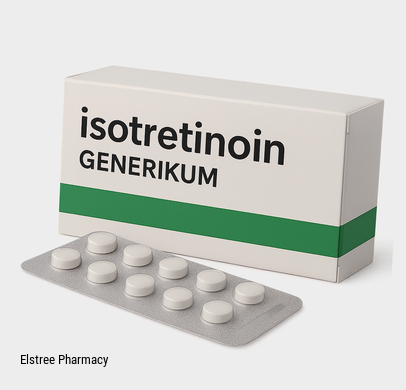
Isotretinoin is a powerful retinoid commonly used to treat severe acne that has not responded to conventional therapies. In the UK, isotretinoin is generally classified as a Prescription Only Medicine (POM) due to safety considerations, strict monitoring requirements, and potential serious side effects. However, some online pharmacies in regulated jurisdictions offer generic isotretinoin without prescription under specific telehealth frameworks or private prescription services. This means you can buy or order generic isotretinoin online in the UK, often at a cheaper or more cheap price than branded products, while still receiving necessary medical oversight. Always ensure the provider is registered and follows MHRA or equivalent safety guidelines.
Isotretinoin, also known as 13-cis-retinoic acid, belongs to the retinoid class: vitamin A derivatives that regulate cell proliferation, differentiation and sebum production. As a potent systemic retinoid, isotretinoin targets multiple pathways involved in acne pathogenesis.
Isotretinoin reduces sebaceous gland size and sebum output, inhibits Propionibacterium acnes proliferation, modulates inflammatory pathways, and normalises keratinisation within the pilosebaceous unit. The cumulative effect leads to reduced lesion count, improved skin texture and, in many cases, long-term remission.
While isotretinoin requires medical supervision, some licensed online pharmacies facilitate a private prescription process. After completing a medical questionnaire and, if required, remote consultation, patients may purchase generic isotretinoin without visiting a clinic in person, making the treatment accessible and often cheaper.
In the UK, medicines are grouped into three supply categories:
Isotretinoin is strictly POM due to teratogenicity risks, lab test requirements, and monitoring protocols. Any online pharmacy offering non-prescription isotretinoin must operate under a private prescribing model or telemedicine arrangement, ensuring that lab tests and risk management programmes (e.g., pregnancy prevention) are in place.
Isotretinoin is indicated for:
Before starting isotretinoin, patients undergo baseline assessments: liver function tests, lipid profile, pregnancy test for women of childbearing potential, and detailed medical history. The protocol ensures that only suitable candidates purchase and use isotretinoin safely.
Generic isotretinoin prices vary according to strength, pack size, supplier and regulatory compliance. Online pharmacies often offer significant cheaper rates compared to branded products. Below is an illustrative table:
| Example Product | Strength | Pack Size | Approx. Price (GBP) | Status | Note |
|---|---|---|---|---|---|
| Generic Isotret UK A | 10 mg | 30 capsules | £45.00 | In stock | Order online, telehealth consult required |
| Generic Isotret UK B | 20 mg | 30 capsules | £75.00 | In stock | Purchase without clinic visit, blood tests needed |
| Generic Isotret UK C | 40 mg | 30 capsules | £120.00 | Limited stock | Online prescription, home delivery |
Prices can differ by currency fluctuations, exchange rates (for imported generics), supply chain costs and private prescription fees. Always compare price per capsule and total pack cost when you buy online.
A generic contains the same active ingredient, isotretinoin, at equivalent strength and quality standards, with different excipients or packaging. Regulatory authorities require bioequivalence studies before approval.
Branded products (e.g., Roaccutane) may carry higher manufacturing and marketing costs. Generics often present a cheap alternative, especially through online suppliers. Both meet the same safety and efficacy standards when authorised in the UK or EU.
Generic isotretinoin can be cheaper per course, improving access. When you order generic without prescription from a reputable online pharmacy, you save on brand premium while obtaining the same therapeutic effect.
Isotretinoin is commonly available in:
Typical treatment courses range from 16 to 24 weeks, with cumulative doses of 120–150 mg/kg. Pack sizes correspond to daily dosing regimens. An online pharmacy may offer mixed packs (e.g., 10 mg and 20 mg) to tailor dosing precisely.
Isotretinoin is the only drug proven to achieve prolonged remission in severe, nodulocystic, or recalcitrant acne. Over 80% of patients experience significant lesion reduction and improved quality of life after a single course.
Treatment usually lasts 4–6 months. Dose adjustments based on weight, tolerance and response are crucial. Online providers often include telehealth follow-up to optimise dosing and manage side effects.
Regular blood tests (every 4–8 weeks) monitor liver enzymes and lipid levels. Women of childbearing potential follow strict pregnancy prevention measures (two negative tests before, monthly tests during, and one test after treatment).
Topical retinoids are first-line for mild to moderate acne. They are available OTC or via P pharmacy supply.
Oral antibiotics (e.g., doxycycline, lymecycline) reduce P. acnes and inflammation. Prolonged use raises resistance concerns.
Oral contraceptives and anti-androgens (e.g., spironolactone) can help female patients with hormonal acne.
Procedures such as photodynamic therapy or laser treatments can complement systemic or topical regimens.
| Feature | Isotretinoin | Tretinoin | Adapalene |
|---|---|---|---|
| Administration | Oral | Topical | Topical |
| Main action | Reduces sebum, keratinisation | Normalises epithelial growth | Modulates keratinocyte differentiation |
| Indication | Severe cystic acne | Mild to moderate acne | Mild to moderate acne |
| Availability | POM (online with telehealth) | OTC/P | OTC/P |
| Side effect profile | Systemic: dry skin, teratogenicity | Local irritation | Less irritation than tretinoin |
No single retinoid is universally superior; choice depends on acne severity, patient preference, tolerability and safety monitoring.
Good skincare routines complement isotretinoin’s effects and help reduce side effects like dry skin and lips.
| Common | Dry lips, dry skin, mild eczema, nosebleeds |
| Less common | Headache, mood changes, muscle aches |
| Rare | Severe depression, inflammatory bowel disease flare, hepatotoxicity |
| Long-term considerations | Ophthalmic issues (dry eyes), lipid abnormalities |
Patients should immediately report severe mood changes, suicidal ideation, persistent headaches or gastrointestinal symptoms. Regular blood tests and clinical review ensure early detection of adverse events.
Most patients complete a single 4–6 month course. Long-term or repeated courses are reserved for relapse cases under specialist supervision. Continual monitoring of liver function and lipid profile is mandatory for any extended use.
Isotretinoin is metabolised by hepatic enzymes; co-administration with CYP3A4 inducers/inhibitors may alter exposure. Always disclose all medications and supplements when you order isotretinoin.
Choose a pharmacy registered with UK or EU regulators, offering private prescription or telemedicine service, transparent lab testing protocols and patient support. Verify MHRA registration, read customer reviews and confirm privacy of your medical data.
Some capsules are designed for content extraction and dose division; however, always follow the supplier’s instructions. Do not alter dosage without professional guidance.
Take the missed dose as soon as remembered unless the next scheduled dose is imminent. Do not double dose. If unsure, contact your pharmacist or medical adviser.
Improvement often begins after 4–8 weeks. Full effect may take up to 16 weeks. Adherence and routine monitoring optimise outcomes.
Some patients report mood swings or depression. Immediate reporting and psychiatric evaluation are essential if psychological symptoms arise.
Visit the MHRA, electronic Medicines Compendium (eMC) or consult your pharmacist. Keep all documentation provided with your prescription or online order.
No. This is general information by Elstree Pharmacy (The Corner Shop B, High Street, Elstree, WD6 3BY). For personal advice, speak to our pharmacy team or your GP.