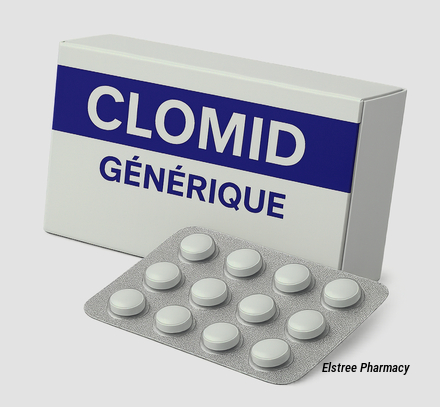
Clomiphene citrate, commonly known by the brand name Clomid, is a prescription-only medicine (POM) in the United Kingdom. This means it cannot legally be supplied without a valid prescription from a qualified healthcare professional. Unlike certain low-dose proton pump inhibitors or antacids, clomiphene is not available over the counter (OTC) or as a Pharmacy (P) medicine. If you see “Clomid without prescription” advertised on the internet, it may be sold illegally or from an unregulated source, which can pose a risk to your health.
However, Elstree Pharmacy offers a secure online consultation service with our qualified prescriber network. Through this service, you can answer a series of clinical questions from the comfort of home, submit your personal and medical details, and, if clinically appropriate, receive a legitimate prescription for generic clomiphene. We then dispatch your order with fast delivery to any UK address. All medications are supplied from our MHRA-registered premises in Elstree, Hertfordshire.
The UK classification system for human medicines is designed to ensure patient safety and appropriate professional oversight. A Prescription Only Medicine (POM) is defined under the Medicines Act 1968 and subsequent regulations. These medicines can only be sold or supplied by a pharmacy when presented with a valid prescription written by a prescriber legally authorised in the UK—typically a doctor, dentist, nurse prescriber, or pharmacist independent prescriber.
Prescription status for Clomid reflects its potential for misuse, the need for careful monitoring of side effects, and the requirement for baseline and follow-up investigations, such as ultrasound scans, hormonal tests, and clinical assessments of ovarian response. Even generic versions carry the same classification, so anyone wishing to purchase clomiphene must go through the prescription process.
Clomiphene citrate is a selective oestrogen receptor modulator (SERM) widely used in reproductive medicine to induce or enhance ovulation in women with anovulatory infertility or polycystic ovary syndrome (PCOS). First synthesised in the 1950s, it remains one of the most frequently prescribed fertility medications due to its relative efficacy, oral route of administration, and cost-effectiveness compared to injectable therapies.
Clomiphene is indicated for women who do not ovulate regularly, have irregular menstrual cycles, or have PCOS. It is also sometimes used in male infertility to improve sperm parameters and endogenous testosterone production, although this indication is off-label in many regions and requires specialist assessment.
The active ingredient is clomiphene citrate. Generic Clomid products contain the same active molecule in equivalent dosage units. Differences between brands and generics relate to inactive ingredients, tablet coatings, packaging, and manufacturing processes, but must meet the same regulatory standards for quality, safety, and efficacy.
Oral administration is preferred for patient convenience, cost containment, and ease of dosing adjustments. Tablets are typically taken once daily for five consecutive days early in the menstrual cycle, most commonly starting on day 2, 3, 4, or 5 after the onset of menses.
A selective oestrogen receptor modulator is a compound that binds to oestrogen receptors in various tissues, acting as an antagonist in some organs (such as the hypothalamus) and as an agonist in others (such as bone). Clomiphene’s main action for fertility is to block oestrogen feedback at the hypothalamus, tricking the body into increasing gonadotropin release.
By preventing oestrogen from binding to its receptors in the hypothalamus, clomiphene reduces negative feedback on gonadotropin-releasing hormone (GnRH) secretion. This leads to an increase in luteinising hormone (LH) and follicle-stimulating hormone (FSH) from the pituitary, which then stimulate ovarian follicular development and ovulation.
FSH promotes the growth and maturation of ovarian follicles, while the midcycle LH surge triggers ovulation. Clomiphene’s pharmacodynamic effect results in a higher endogenous release of these hormones, improving the likelihood of ovulation in patients who would otherwise have irregular or absent cycles.
No. Clomiphene does not chemically neutralise oestrogen. It modulates receptor activity, altering feedback loops to achieve therapeutic effect. Unlike antacids or acid reducers, it works via endocrine system modulation rather than chemical neutralisation.
Price for a 50 mg pack of 20 tablets varies by supplier, retailer promotions, generic manufacturer, and prescription dispensing fees where applicable. As a POM, prices combine the medication cost and the professional dispensing charge. Via our online service, generic Clomid is competitively priced, with bulk buy or subscription discounts available for repeat cycles.
Clomid’s market price can vary due to manufacturer, pack size, pharmacy mark-ups, shipping fees, and local NHS dispensing regulations. In some cases, a private prescription may include additional consultation fees. Elstree Pharmacy aims to keep costs transparent, listing all charges upfront before you confirm your order.
| Example | Strength | Formulation | Price (GBP) | Status | Note |
|---|---|---|---|---|---|
| Generic Clomid A | 50 mg | Film-coated tablets | £24.99 | Prescription Only | Valid prescription required |
| Generic Clomid B | 50 mg | Film-coated tablets | £19.50 | Prescription Only | Online consultation available |
In the UK, clomiphene tablets are commonly available in 50 mg doses, the standard starting dose for ovulation induction. Lower doses (e.g., 25 mg) may be compounded or halved for dose adjustment. Higher doses up to 100 mg daily have been used under specialist supervision for resistant cases.
Clomiphene is supplied almost exclusively as oral film-coated tablets. There are no generic capsule or liquid formulations widely marketed in the UK. Each tablet must be swallowed with water, typically in the morning to maintain steady blood levels.
Standard packs contain 10, 20 or 25 tablets, sufficient for two to five cycles at 50 mg daily for five days per cycle. Pack size influences cost per tablet and overall order total. Large packs may offer marginally lower per-tablet pricing but require secure storage and patient responsibility to avoid misuse.
| Feature | Why it matters |
| Active ingredient | Clomiphene citrate, the ovulation-inducing agent |
| Strength | Determines hormone response and cycle regulation |
| Formulation | Tablet coating affects bioavailability and shelf stability |
| Pack size | Cycle coverage and cost efficiency |
| Legal category | Requires a valid prescription and professional oversight |
Generic products contain the identical active moiety and must demonstrate bioequivalence to reference brands. Differences in excipients, tablet colour, shape, and imprinting are permitted. All licensed generics in the UK meet MHRA standards for quality, safety, and efficacy.
The main licensed indication is anovulatory infertility in women who fail to ovulate or have irregular menstrual cycles. It is particularly common in PCOS management.
Clomiphene is sometimes prescribed off-label to men with hypo-gonadotropic hypogonadism or oligozoospermia. By increasing endogenous gonadotropins and testosterone, it may improve sperm parameters. However, evidence is mixed and specialist supervision is recommended.
A typical course is five days per cycle. Ultrasound monitoring or mid-luteal progesterone measurement may guide cycle timing and confirm ovulation. Treatment usually continues for up to six cycles before evaluating response and considering alternative therapies.
If ovulation does not occur by a specified cycle threshold, or if side effects become unacceptable, a clinician may discontinue clomiphene and explore other treatments, such as letrozole or injectable gonadotropins.
Clomiphene presents potential risks including ovarian hyperstimulation syndrome, multiple pregnancy, and vision disturbances. Prescription control ensures appropriate patient selection, dose monitoring, and follow-up investigations.
Only with a valid prescription. Pharmacists cannot legally sell or supply clomiphene without seeing an authorised prescription. Remote prescribing through an online medical consultation is permitted under MHRA guidance, provided the service has a valid prescriber oversight mechanism.
The General Pharmaceutical Council (GPhC) oversees pharmacy practice, while the MHRA regulates medicine licensing and prescribing frameworks. Both bodies ensure patient safety and compliance with UK law.
Gonadotropins such as FSH or HMG injections are used when oral agents fail. These require specialist clinics, ultrasound monitoring, and carry higher costs and risks of multiple pregnancy.
Letrozole reduces oestrogen synthesis rather than blocking receptors. Some studies suggest higher live birth rates and lower risk of multiple pregnancy in PCOS patients, making it a preferred first-line agent in many fertility centres.
Both induce ovulation but via different mechanisms. Letrozole inhibits aromatase, reducing oestrogen production, whereas clomiphene blocks oestrogen receptors. Clinical trials show similar ovulation rates but letrozole may yield higher live birth rates and fewer side effects in PCOS populations.
Injectables provide direct hormone supplementation and can be tailored for dose and timing. They have higher efficacy in refractory cases but carry greater cost, require clinic visits, and have higher risks of ovarian hyperstimulation syndrome (OHSS).
| Feature | Clomiphene | Letrozole | Injectable FSH |
| Mechanism | SERM: blocks oestrogen receptors | Aromatase inhibitor | Exogenous gonadotropin support |
| Route | Oral | Oral | Injection |
| Monitoring | Optional ultrasound | Optional ultrasound | Mandatory ultrasound and blood tests |
| Multiple pregnancy risk | ~5–10% | ~3–7% | ~15–25% |
No single agent suits every patient. Choice depends on underlying diagnosis, prior response, ovarian reserve, cost considerations, and patient preference. Shared decision-making is key.
Body mass index (BMI) can influence ovulation and hormone balance. Weight loss in overweight women with PCOS can restore spontaneous ovulation and improve response to clomiphene.
A balanced diet with low glycaemic index carbohydrates, adequate protein, and healthy fats supports metabolic health and hormonal balance. Nutrients such as vitamin D, inositol, and antioxidants may offer adjunctive benefits.
Both can impair fertility outcomes. Smoking reduces ovarian reserve and may increase risk of miscarriage, while excessive alcohol can disrupt hormonal cycles and reduce implantation rates.
High stress levels may negatively affect ovulation and uterine receptivity. Stress management techniques—yoga, meditation, counselling—can improve psychological well-being and potentially support treatment success.
Yes. Common adverse effects include vasomotor flushing, breast tenderness, headache, mood swings, and gastrointestinal discomfort. Visual disturbances and ovarian enlargement are less common but warrant immediate review.
| Area | Examples described in product information |
| Neurological | Headache, dizziness, visual blurring |
| Gastrointestinal | Nausea, abdominal discomfort, bloating |
| Psychological | Mood swings, irritability, depression symptoms |
| Reproductive | Ovarian enlargement, multiple pregnancy |
| Allergic | Rash or hypersensitivity reactions |
Regulatory guidelines mandate listing all known or suspected adverse events to inform patients and healthcare professionals. Frequency categories range from very common to rare or very rare.
Most clomiphene courses are short-term over several cycles. Long-term continuous use is uncommon. Concerns about ovarian cancer risk or endometrial changes have not been conclusively proven but underline the need for monitoring.
Monitoring ensures appropriate ovarian response, minimises risks of OHSS, and helps adjust dosing. Baseline pelvic ultrasound and serum hormone measurements guide safe prescribing.
Clinicians typically reassess after six ovulation induction cycles. If there is no pregnancy or ovulation remains inadequate, further investigations or alternative therapies are considered.
Repeated intermittent courses are generally well tolerated. However, persistent ovarian enlargement or endometrial thickness >10–12 mm may necessitate treatment pause and specialist assessment.
Yes. Clomiphene is metabolised via hepatic enzyme systems. Concomitant medications affecting CYP2D6 or CYP3A4 can alter plasma levels. Combined use with tamoxifen or high-dose oestrogens is contraindicated.
Visual disturbances such as blurring or scotomas are rare but reversible if clomiphene is discontinued promptly. Any new vision changes require immediate medical review.
Clomiphene is used to induce pregnancy but should not be continued once pregnancy is confirmed. Prenatal care then follows standard obstetric guidelines, and any potential teratogenic risk is considered negligible after ovulation induction.
A generic medicine contains the same active ingredient as the reference brand. It must demonstrate bioequivalence and meet the same quality, safety, and efficacy standards. Generic packaging and excipients may differ, but clinical effect is equivalent.
Different marketing authorisations may specify various inactive ingredients, warnings, and pack sizes. Always read the specific patient information leaflet included with your medicine.
Reliable sources include the MHRA website, the electronic Medicines Compendium (eMC), and professional pharmacy advisors. Always refer to the latest authorised product information.
No. This page provides general information by Elstree Pharmacy (The Corner Shop B, High Street, Elstree, WD6 3BY). For personalised advice, please consult our pharmacy team or your GP.